There is a Flame That Never Goes Out – Reflections on the Olympics

//
// <![CDATA[

// ]]>

Missiles on roofs, a warship in the Thames and a no fly zone…it’s all a far cry from the previous London Olympics of 1948. They called that one ‘The Austerity Games’. Coming on the heels of World War II, it was a shoestring budget in comparison. But no one feared someone would plant a bomb in buy generic cialis online one of the stadiums. The Olympics is a sporting event at its core still but it’s also an exercise in security, political sabre rattling and an expensive display of national showing off.

Time was when the opening ceremony was a simple parade of the athletes. Now the money spent on the ceremony could keep a small country going for a year or two. Each one tries to outdo the one before. Lots of people cavort around in colourful but baffling costumes, acting out historic and cultural references that the commentator struggles to interpret. There’s a lot of symbolism and national pride and symbolism and storytelling and… more symbolism.

Having said that, the Beijing opening shindig was jaw-droppingly amazing. Surely London can’t compete with that? Enter Mr Danny Boyle, director of Trainspotting, Slumdog Millionaire and 127 Hours. If his direction of the opening were to reflect his back catalogue, we’re in for babies crawling across ceilings, Bollywood dancing and trapped rock climbers hacking off their limbs. Alas, we’ve been told we’re getting farm animals. Yes, farm animals. Choose pigs. Choose cows. Choose sheep. It doesn’t sound promising but given Doyle’s pedigree, I have to keep faith. As long as Boris doesn’t take part, we’ll be okay.

An entourage of sports psychologists and nutritionists fine-tune today’s sportsmen and women whilst agents build up the image of the potential gold medallists. A gold medal is a ticket to a lucrative media career. Now, what would Alf make of all this malarkey? Men of a certain age (and old tomboys like me) will remember Alf Tupper, the working class lad who graced the pages of The Rover and The Victor. He would finish up his welding and scoff his fish and chips before competing in the mile, winning ahead of his toff rivals, of course, and then get the train home. He would have told a nutritionist where to go, all right.

There’s a real sentiment at the heart of both the summer and winter Olympics. It’s based on individual stories of years of sacrifice and striving for excellence and teary-eyed champions on the podium with proud parents in the crowd. A few bars from ‘Chariots of Fire’ and we all melt. Politicians and governments sometimes rain on our parade, however. There’s a lot of national posturing, appeasing and old scores to be settled. Of course, political baggage has always shadowed the Olympics. The 1936 Games in Berlin was a platform for the Third Reich. America boycotted the 1980 Games because of the Soviet’s invasion of Afghanistan. For sport to be purely about sport, all human activity would have to be pure.

But all this will be forgotten – just for a few minutes – as we watch these men and women run faster and jump higher than anyone ever did before. The glow from the Olympic flame will mean something once more, before the foolishness of the human race extinguishes it again.

Are gaming notebooks worth it?

One of the most heated debates on the internet is whether spending close to double what you would spend building your own desktop is worth it. As you are reading this, a few brands may immediately pop into your head such as Alienware, MSI, Asus and perhaps even Medion. The greatest challenge for me whilst writing this is to stay objective as I myself am current typing this on my third Alienware laptop.

Alienware

I will use my accounts of owning a “gaming” notebook to help any reader make their own minds on whether owning such a machine is worth all that money spent. On Monday, UPS delivered to me my M17x R4, which was kindlly given to me by Dell to replace my M17x R3. First off and most importantly is the price – one may pay in the region of two grand for this “portable” computer and that is not counting the upgrades I will add throughout the course of the single year that I will own it before the draw of newer tech forces me to upgrade. With that money, I could have built myself a pretty beefy desktop will all the metaphorical bells and whistles and actual bells and whistles if I wanted to. The main reason is that I move around, a lot. And that makes owning a desktop out of the question. I carried my old M17x R3 back and forth in a backpack but honestly, I wish it didn’t need to. This 17 incher is about twice as thick and probably twice as heavy as the 17 inch MacBook Pro. For many, the weight and size of any gaming notebook is a definite deal breaker. The laws of physics just cannot be bent – power equals heat and a sleek slim form factor like that of the MacBook Pro just cannot contain that much heat produced by the much more powerful components inside.

MacBook Pro...seriously?

So what about performance then? By now you may be thinking, maybe I can look past the bulkiness of the laptop as long as it provides me with what I need in terms of performance. A user should be buying a gaming notebook in order to play games, otherwise they are just plain stupid. The single feature of any gaming notebook that differentiates it from the crowd should be its graphics card. At the time of purchase, my Alienware M17x R4 had a GTX 660m as its base configuration; I configured mine with a GTX 680m, the top of the line notebook GPU at this time of writing. Do not fall into the trap of the naming schemes of mobile graphics cards compared to desktop ones. A GTX 680m is a far cry from the desktop GTX 680 but instead similar to a desktop GTX 670 with lower clock speeds. Now, the GTX 680m is able to pump out decent frame rates in most of the modern games with the exception of a few. Games such as Call of Duty – Modern Warfare 3 and Battlefield 3 all run with playable frame rates with details set to their maximum. Alienware is also not the only company offering this particular graphics card. Other gaming notebook lines such MSI and Clevo (resold by pwnpcs and PCSpecialist here in the UK) have their variants of the GTX 680m. Of course, for those that need to save a few quid, there are other configuration options such as AMD’s very respectable 7970m (comparable to a desktop 7870) and the lower GTX 660m offering mid- to low-tier graphics performance. For those looking to buy a gaming laptop, you MUST do your research as naming schemes like these are often used to catch users out with them spending lots of money and only receiving mediocre performance.

When reading this, some may have gone to the Dell website and configured a system to their own liking and noticed that the GTX 680m is much more expensive than the AMD 7970m despite being only a few percent quicker. Nvidia has generally always charged more for its flagship mobile GPUs and the rationale is that they offer more features such as PhysX and in the case of the M17x R4, 3D. That’s right, my rig has a Full HD 1080p 3D display utilising Nvidia 3D Vision 2; glasses come standard. Despite the AMD GPU being fully capable of driving a 3D display, Dell has chosen not to implement this so 3D = Nvidia. For those that have been wondering why I’m talking about Dell, Alienware is owned by Dell; all the warranty, repair and customer service is handled by them.

The next best thing about a gaming notebook is the potential upgradability. My M17x R4 is configured with the lowest Ivy Bridge i7 that Dell offers – the i7 3610QM. The CPU is no slouch with four cores and a CPU speed of up to 3.3Ghz (2.6Ghz when all four cores are on full load) but there were better CPUs which could clock up to faster speeds at a premium. The reason I went for the lower CPU was because unless you are doing CPU intensive work such as video rendering and data processing, other programs, which may seem intensive such as games, do not fully tax the CPU. Plus for paying customers, it is also the cheapest option. I also went for the least amount of RAM at the slowest speed because I knew that RAM would be easily upgradable for cheap. The CPU is upgradable and a few months down the line, I can decide to be adventurous and buy an i7 3920/3940XM CPU. The “XM” highlights that it is the extreme edition of the mobile processors and it has an unlocked multiplier. The unlocked multiplier is an enthusiast’s dream as it allows the user to define the clock speed of that they wish to run the CPU at (overclocking) provided there is sufficient supply of power and they can keep temperatures under control. I had a play with the same last generation i7 2920XM in my M17x R3 and successfully managed to increase the CPU from its default highest clock of 3.5Ghz all the way to 4.6Ghz running on all cores; stable albeit very hot under load. I had also replaced the 4GB of RAM that came with the laptop with 8GB running at a faster clock speed. This upgradability can be seen across all gaming laptop brands.

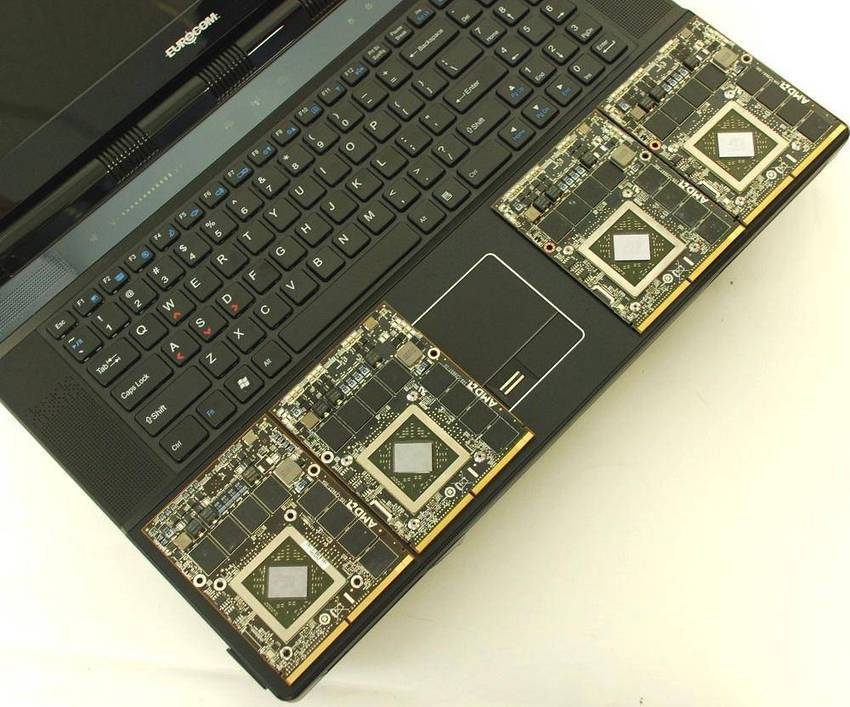
A few laptop vendors such as Alienware, MSI and Clevo allow graphics card upgrades. Mobile GPUs that are removable come in the MXM form factor and are hard to come by, and are very expensive when purchased separate. Visit the forums to find out more. Below are four of these modules for a size comparison against a 17 inch laptop.

4 MXM graphics modules.

The single greatest upgrade that a user can perform on any laptop will be changing the regular spinning HDD (Hard Disk Drive) with an SSD (Solid State Drive). SSDs use flash storage similar to those found in SD cards and memory sticks and offer far quicker performance compared to regular hard drives. My computer boots from cold to usable desktop in under 15 seconds, a feat unachievable when using an ordinary HDD. Games load quicker and the system is noticeably snappier. There will be an upcoming post focusing on the benefits of SSDs so stay tuned.

As of 2009, the laptop market finally overtook the desktop market. More people are buying laptops compared to desktops but there will still be religious system builders that will consider a gaming laptop a plain waste of money. The truth is that laptops will always perform one or two steps slower than any desktop built with even half its cost. For 2-3k, the only reason for a buyer to look at the possibility of buying a gaming notebook over a desktop is to have some performance on the move. I have heard people wanting to buy these flashy systems plainly to show off to their friends. Speaking from experience, the stares and gasps are only good the first time. After that, you are left at the back of the group desperately trying to drag your monstrosity of backpack onto your already painful shoulders and just looking like an idiot. Gaming laptops are the best for LAN parties and gaming on the move and that’s about it. They will offer far more features than any ordinary notebook or ultrabook such as dedicated graphics, quad-core overclocked processors, 3D displays and even WirelessHD but they are almost always way overpriced. The single best advice I have given anyone wanting to buy one of these is this: Never configure one online and press buy, phone up and haggle. Dell sales reps are paid by commission so they’ll be willing to budge on price and throw in an extra thing or two, and never over configure, pay for only what you know you cannot upgrade anymore, then buy the rest on eBay.

Film Review: Double Indemnity

Well, yesterday it happened to me again (and I don’t mean another bout of embarrassing public itching). I watched an amazing old movie for the first time and wondered how on earth it is I’d never seen it before. ‘Course, I’d heard of it somewhere, sometime but never felt inclined to watch it. Maybe it’s the film’s title, I don’t know. But having recently read a biography of Raymond Chandler – that wittiest and most influential of all hard-boiled crime writers – and learning that he had, in the 40s, worked as a screenwriter in Hollywood and had in fact co-written Double Indemnity, I sought it out and gave it a viewing.

Chandler is perhaps most famous for creating the character of Phillip Marlowe, the private detective that was made universally famous by Humphrey Bogart in The Big Sleep in 1946. His distinct writing style and in particular, his ability to pen incredible dialogue has been often parodied but never bettered. This “Chandleresque” touch is clearly evident in Double Indemnity as the actors deliver their lines.

The story, based on a novella of the same name by James M. Cain, begins when Walter Neff (Fred MacMurray) an insurance salesman for Pacific All Risk makes a routine house call on Phyllis Dietrichson (Barbara Stanwyck) to renew her husband’s car insurance policy. There is an instant attraction between the two and plenty of flirting takes place until she asks about taking out a life insurance policy on her husband without his knowledge. Neff understands immediately that she has murder in mind and does what any sane insurance man would do and gets the hell out of there. But later that evening, she turns up at his apartment and continues to seduce him and before long, his gullibility and lust for her vanquishes his caution and the two agree to kill her old man.

Neff, being a hotshot insurance man, knows all the tricks of the business and comes up with a foolproof plan to get rid of Mr Dietrichson in such an unlikely way that it will trigger the “double indemnity” clause of the policy thereby making Pacific All Risk liable to pay Phyllis twice the policy amount of $50,000. The plan (which I won’t divulge so as not to spoil the film for those of you who haven’t seen it) goes off pretty smoothly and before you know it, the mourning Mrs Dietrichson is preparing to get her blood-stained hands on the dough.

But Neff’s friend and colleague at Pacific All Risk, Barton Keyes (Edward G. Robinson, who plays a claims investigator) begins to smell a rat and although the head of the company believes the death to be suicide and is willing to settle the claim, Keyes persuades him otherwise by quoting a bunch of statistics on the probability of suicide. There are further complications for Neff when he becomes friendly with the victims daughter who believes Phyllis is responsible for her father’s death and…under the masterful direction of Billy Wilder the tension grows and grows.

As a film noir, it really is one of the finest American examples and clearly set the standard for those of the genre that would follow. The dialogue is a thing of beauty (typical Chandler), the acting is faultless – particularly Edward G. Robinson who in my opinion steals every scene he’s in – and the black and white cinematography is superb. The way they used light and shadow and silhouettes in those days was simply genius. It was nominated for seven Oscars but bizarrely failed to win any but in recent years it has been recognised in all manner of the American Film Institute’s 100 Years…100 something or other categories.

Stanwyck plays her femme fatale with controlled coolness and MacMurray is ideally cast as the charming yet somewhat weak willed louse. It’s interesting to note they were both playing against type in these roles and equally interesting that they were also the two highest paid stars in Hollywood around the time of filming. Robinson is always value for money and despite being third on the bill, he received the same pay as the two leads. To watch the scene where he’s spouting statistics is to watch a true pro at work. Sublime stuff. And if you don’t blink, you’ll even see Raymond Chandler in a one-off cameo (and the only known film footage of him in existence), sitting in a chair as Neff walks by on his way from Keyes’ office.

The film noir genre is probably something that I’ll come back to soon because there are a great many movies worth writing about and watching but for now, if you’re in a mind to watch just one, watch this one. You won’t be disappointed.

Formula One on the streets of London

I spy rumours around the Internet that one possible future usage of the Olympic Stadium could be a Formula One race circuit. Apparently, Intelligent Transport Solutions Ltd of London have been in discussion with F1 supremo Bernie Ecclestone regarding the prospect of bringing the world’s most glamourous high-octane circus to town. And what a prospect it is!

The route would likely see McLarens, Ferraris et al racing inside the stadium as well as around the Olympic Park and while it wouldn’t have the added glamour of multi-million dollar yachts moored casually nearby like Astra vans parked in a supermarket car park as does Monaco or Abu Dhabi, it would have impressively modern facilities and arguably one of the more scenic circuits on the calendar . I don’t know about you but the promise of twenty or so V8s screaming around a manicured park in the East End of London is a mouthwatering one.

Yes, I know what you’re thinking – “They’ve been talking about a London street circuit for years” – and while that’s true, it seems a lot more likely to happen now that there is a suitable site that can be used without bringing the capital to a complete standstill. Although Ecclestone has elsewhere stated that plans for a London circuit that would take in such landmarks as Buckingham Palace and Big Ben were “no joke”, I find it a little harder to imagine cars racing down Whitehall, navigating the Parliament Square chicane and hitting the Birdcage Walk DRS zone than I do around the Queen Elizabeth Olympic Park. Logistically, the new site would be much less of a headache for the organisers.

Of course, Silverstone, the current home of the British Grand Prix is scheduled to host the event for the next 17 years and much investment has and is being injected into the site because of this however, this doesn’t put a lid on the Olympic Stadium proposal. It simply means the UK would host two, count them, two Grand Prix meetings each season. So, all you race fans out there, how cool would that be?

This Girl-on-Girl Action Ain’t Sexy

I was recently utterly enraged by a couple of articles on the Metro website, which claimed that women should know by now that it is practically illegal to venture out in public without first either shaving or waxing their underarms, and that to transgress this long-established social law is to announce to the world that they are disorganised, dirty, and lacking in self-respect and in that mysterious quality known as “class”. To let other people see your hairy pits, claimed the author, is both disgusting and unacceptable.

The articles focused on the so-called “major beauty faux pas” made by Pixie Lott at the London premiere of the latest Batman movie, at which she flashed a spot of pit fuzz; the journo in question likened it to a similar incident over a decade ago when Julia Roberts proudly aired her (admittedly rather more copious) armpit-carpet at the London premiere of Notting Hill. The photographers went nuts on each occasion, of course, which is why these non-events got in the news.

Stunned that such petty bile could be deemed true journalism, through a red mist I scanned the offending pages. I was looking for the name of this perpetrator of male chauvinism and despicable misogyny, this no doubt doddery old bastion of alpha male behaviour holding out stubbornly against the progressive views of a modern society. And then I found it. Amy Duncan. Hmm, that’s a funny name for a bloke.

Well, it turns out that I’m just plain old naïve – and, in my own way, sexist – because not only is this woman expounding the views I most commonly associate with “unenlightened” males, but she is very much not alone in this activity. Apparently, tearing down the fragile walls of female self-esteem is extremely lucrative – if you’re a woman. The Daily Mail’s “Femail”, for example, is a veritable breeding-ground for these shallow, scathing and often pointless attacks on women, by women. It’s big business – but why?

According to psychology studies conducted at two universities in Canada last year, women are programmed to behave this way. We’re in competition with other members of the same sex, and often feel threatened by those we perceive as more attractive than ourselves, which invariably leads to hostile behaviour, such as that which abounds in most newspapers and in every women’s magazine on the market. The authors of the studies, T. Vaillancourt and A. Sharma (both female, just so you know), maintain that once we have acknowledged this behaviour we can begin to address it. After all, if we were incapable of breaking our programming and of controlling instinctual behaviour, then rape and paedophilia would be socially acceptable. Saying that women are “born to be bitchy” (thank you, Claudia Connell of the Daily Mail, for that one) is really just an excuse for not trying to improve our behaviour – but I doubt that women like Amy Duncan will ever amend their views based on such silly things as rational arguments, scientific studies and the ideal of behaving decently to their fellow humans.

Oh, I should be sorry for picking on you, Amy – after all, you’re just one of many awful women who seem hell-bent on making the rest of us feel like shit, and singling you out sort of makes me as bad as you, I suppose. I promise, though, you were just the closest example to hand (I did try picking on Liz Jones, but that’s a real minefield there). I mean, come on – you’re condemning Julia Roberts for being “totally unaware of the furore she had created” when people caught sight of her armpit hair, all those years ago. You know why she was “totally unaware”? Because it wasn’t a “furore” to her; it wasn’t even an issue. And to judge by Pixie Lott’s lackadaisical Twitter response to this latest outcry, it isn’t an issue to her either, so your horrified bleating is a bit of a lost cause there as well. I’d love to know why this kind of thing bothers you – and so many other women – so much. Going by the results of Vaillancourt and Sharma’s studies, I would assume you feel threatened by these beautiful celebs, who are so imbued with self-confidence that they can happily attend high-class functions without worrying themselves into a frenzy over whether someone might be judging their armpits. Or perhaps you are genuinely disgusted by body hair on a woman, in which case I would imagine that you’ve been made to feel ashamed of your natural physical state over the years, which again points to low self-esteem. Is this why you’re trying to make other women feel insecure: so you’re not alone?

As someone who has always been just a bit paranoid about her own underarm hair, mostly as a result of knowing that these callow bitches are on the lookout, what surprised me most about the photos of Pixie and Julia was how un-gross a healthy crop of pit fuzz looked alongside a pretty dress. Sure, it was different, but it was also completely natural and entirely their own damn business. It’s emboldened me, pit-wise, I have to say. Certainly less “disgusting” than, say, a red-raw axilla cut almost to the bone by over-shaving, or sporting the red welts that so often come after a wax. I’m not in the habit of elevating pop singers and actresses as role models, but on this occasion these confident, carefree women are leading the way, whereas the venomous proclamations of Amy, Liz and all those other self-haters are just holding us back.