
This week’s video shows the remarkable leap Nokia has made with mobile photography
This week’s video shows the remarkable leap Nokia has made with mobile photography
There’s little doubt in my mind that by the end of the year, Christopher Nolan’s epic conclusion to his Dark Knight series will be top in box-office takings. I’m not a skilled mathematician in any way, shape or form but I believe if you deduct the extra earnings that The Avengers ripped off took from its 3D advantages (you know, an extra £1.50 for a tainted experience and over-sized glasses), then The Dark Knight Rises comes out on top. I’m sure far cleverer and wiser people than myself will tell you this is not the case though*
*it is.
But it doesn’t matter; at the end of the day people aren’t going to clamber home and divulge their full feelings and thoughts on the movie based on how much money it raked in. The age-old saying about quality and quantity comes into play massively here. Box-office success has never and will never equal critical acclaim – just ask Michael Bay.
Again, it doesn’t matter; no one is going to clamber home at the end of the day and sa—oh, I’ve done this part. Well, forgive my sanctimonious ramblings about film politics. The movie itself is wonderful. It’s a wonderful movie. It’s fantastically ambitious in scope and executed with the deft precision we’ve come to expect from Nolan’s skilled hands. It also brings up an interesting question:
Is it a good Batman movie?
Was The Dark Knight? As far as I’m concerned, Batman Begins represented the character of Batman as I, a comic-book virgin, would expect him to be portrayed. It felt like it jumped right out of the murky pages of a traditionally dark graphic novel with its steam-soaked streets, colourfully off-beat characters and, well…a guy dressed as a bat. Then The Dark Knight came along and, perhaps juiced up by Heath Ledger’s tragic death, the fan-boy community was given a sudden jolt of excitement; anticipation for this movie was sky-high and it delivered on all the right notes. I’m going to shamelessly quote famed movie-critic Roger Ebert on this one because he says it better than most:
“Christopher Nolan’s “The Dark Knight” is a haunted film that leaps beyond its origins and becomes an engrossing tragedy”.
So that’s what Roger says and I agree whole-heartedly. It took Batman to a new level (for me at least) and gave us all a healthy dose of entertainment along the way. In a way it’s raised the bar for what many believe a good Batman movie should be (to be straight, I don’t quite agree with this as I really enjoyed Tim Burton’s gothic-inspired effort in 1989).
The Dark Knight Rises tries so hard to do this again and upon my second viewing, I noted the scope of the film; what Nolan tried to achieve was amazing; an entire city is ripped apart from inside, both politically and socially, and then stapled together precariously whilst awaiting the heart-pounding climax. It’s what Nolan loves to do and though I don’t think he truly achieved the successes he had with The Dark Knight, you have to stand up and applaud the guy. It’s no easy task and I doubt I could do it*
*I couldn’t.
That being said, I’d hardly label the movie a ‘failure’; its undertones and themes are convoluted and many plot-points are far too convenient and far-fetched. I’ve read thousands of plot-holes related to the movie and though I agree many of them raise an eyebrow or two, I would suggest that Nolan’s movies are perhaps slightly more exposed to quizzical wonderings from the online community due to the director’s stature which has truly polarised some as well as captivated others. I admit I’m a big fan; I wrote my university dissertation on the guy and the way in which he’s crossed the boundary between Indie and Mainstream without as much as a scratch on him. He’s a remarkable film-maker and whilst I will never be as arrogant and pompous to label him one of the greats, his contribution to Hollywood has left a significant mark.
Also, stop asking:
“How does Bane eat?”
Did you ever ask how Darth Vader ate? Perhaps he was a big fan of the suffragette era and took to consuming his daily meals through a narrowly worked straw.
I liked Bane. I liked the music (I like to imagine someone following Bane down the street, beating enthusiastically on a pair of drums slung over their chest). I liked Catwoman. I liked her outfit. I liked Michael Caine crying. I liked the special effects. I liked Joseph Gordon-Levitt being called *SPOILER* Robin and I liked Bane beating people up with a bike-helmet.
There’s a whole collection of great things to like about this movie, but I think love is perhaps an expression too far. The movie goes places that it perhaps needs to go but I don’t know how much it sacrifices audience entertainment for; the fight scenes are very well orchestrated with Bane matching Batman for physical strength with interest. Tom Hardy has a good time as the muscular and intimidating figure of Bane and his presence is felt throughout the movie, even when he’s sadly not on screen. Elsewhere, Anne Hathaway shoves her previous critics away with a flawless, confident and humorous performance as Selina Kyle (Catwoman is never once uttered) and her role is used well by Nolan as is the role of John Blake, played by Joseph Gordon-Levitt. A lot of characters, a lot of balancing; I admit I was surprised at the lack of Christian Bale as the Batman. He has quite a journey of discovery in this movie and Bale probably puts in his best performance of the trilogy as a Bruce Wayne completely devoid of hope.
By the end you’ll appreciate the action that has unfolded; as always, it’s second-to-none and the urgency of the film’s events is felt throughout. Nolan has his pacing covered and it’s definitely a movie that you could see more than once without feeling like you need to stealthily check the time on your phone.
The story is rather insignificant at the end – I don’t think many will care for the ‘Save The World’ idea that is thrown about rather lethargically towards the beginning of the film and plot-points seem to follow suit, being branded about left, right and centre until dropped completely for the explosive ending. It’s a movie that deserves its plaudits and the money earned but it never quite reaches the heights set by its predecessor and perhaps even Whedon’s Avengers, but it’s worth-watching as always and paints a beautiful picture thanks to the sublime efforts of cinematographer Wally Pfister.
Well, I don’t know about you but my weekend was wet and windy and, compared to of late, pretty darn chilly. At least for August. Had it been more clement, I would probably have busied myself with one or two little jobs that are awaiting my attention outside. Or I might have taken a languid stroll around the park. Alas, Hey Ho! the weather kept me indoors. So what better way to spend a wet Sunday afternoon than to watch an old sun-drenched western, particularly one directed by Anthony Mann whose CV includes some of the finest of the genre ever made.
While it may be easier to recall the more famous Mann westerns starring James Stewart, of which there were five (starting with Winchester ’73 in 1950 and ending with The Man From Laramie in 1955), The Tin Star, made two years later, stars Henry Fonda and Anthony Perkins. This time, instead of one main protagonist – the emotionally tortured soul that Steward embodied so well – here we have two main characters – Fonda’s laconic and sagacious bounty hunter and Perkins’ young and inexperienced town sheriff. There are no sweeping vistas of snow-capped mountains, beautiful pine sided valleys or white-water gorges here either, an element that Mann captured so beautifully in those earlier films. Indeed, in complete contrast to the Stewart films, there is no travel at all involved for the characters here, not in a geographical sense anyway. The only journeys undertaken are in the characters of the characters, if you get my drift.
It is dialogue that drives this movie forward more than an cross-country pursuit peppered with gunfights, that and the influence that Fonda’s age and experience has on Perkins’ naivety. Apart from a couple of forays out into the surrounding dusty countryside, the action takes place in a little old town in the middle of nowhere. It’s shot in black and white too which seems to add to the film’s parched appearance. Also worth noting is that the film opens with a shot of the town’s main street as Fonda trots in on his horse and closes with exactly the same shot with him riding out in a buggy. Whether Mann meant anything by this is down to one’s interpretation.
And so to the plot. Morgan Hickman (Fonda) rides into town with a dead outlaw slung over his pack horse. He goes to the sheriff’s office to claim the bounty on it. The townsfolk don’t want him around because bounty hunters are bad news. Ben Owens (Perkins) has been appointed temporary sheriff by the townsfolk (the last one having been killed) on account nobody else wants the job. Nobody that is, but the town bully Bogardus (Neville Brand) who would use the post as a licence to kill.
Owens is a likeable young man with a rather unconfident manner and a sweetheart who won’t marry him while he’s wearing a star and Bogardus is a distinctly nasty piece of work who has the townsfolk standing behind him because they’re all afraid of him. He is a racist bully and it’s not long before he shoots an Indian in the back claiming it was self-defence. Owens swallows hard and steps forward to do his job but Bogardus resists arrest, prompting Hickman to step forward and lend an experienced hand.
Hickman has to stick around a day or two while his bounty claim is processed and gets lodgings with widow Nona Mayfield (Betsy Palmer), a young woman who lives just outside of town with her son, a half-Indian boy named Kip (Michael Ray). Strong feelings rapidly develop between Morgan and Nona and Kip is thrilled to have a father figure around.
With Bogardus released from jail after witnesses claim he did indeed act in self-defence, the young sheriff asks Hickman for some coaching on how to become a better sheriff. Hickman, at first reluctant, telling Owens to quit while he still can and go marry his girl, has a change of heart when he admits to having once been a lawman himself before turning bounty hunter. For all his naivety, Owens is a decent, upstanding man but simply lacks the basic knowledge of being a lawman. He has the heart but not the tools. So Hickman begins to advise the younger man.
Later, the town doctor is murdered by two brothers and the town demands justice. Owens is adamant he wants to bring the perpetrators back alive so they can face a fair trial but Hickman is certain that filling them with lead is the only way the brothers will allow themselves to be brought in. Bogardus takes off with a large posse to capture them, his intention to string them up from the nearest tree.
With Hickman’s help, the brothers are taken alive by the sheriff and thrown in jail. But the rowdy posse – headed by Bogardus – threatens to storm the jail and hang the brothers in the street. Owens, having learned much from Hickman in the last few days, faces the crowd and Bogardus and soon earns the respect of the town. He is now the competent lawman he wanted to be. The film ends on a happy note with Hickman riding out of town to start afresh somewhere else a changed man, with a new woman and a young boy beside him.
Overall this is a very good film and an often overlooked western gem. The acting is terrific from a strong cast, particularly from the two leads. Fonda, who in my opinion, is always worth his fee, plays the jaded hero figure with just the right blend of cruelness and compassion. Sure, he’s as mean as hell, he’s got to be, it’s a tough job and someone has to do it. Perkins, who was only twenty five and in one of his first roles portrays being wet behind the ears at the outset with real honesty but by the end of the film, he’s grown in stature and maturity. A great performance from him.
The screenplay written by Dudley Nichols from a story by Joel Kane and Barney Slater was nominated for an Academy Award, something that very rarely happened to low budget westerns at the time (or ever). There are words of wisdom in Hickman’s dialogue as he tries to instruct Owens in the art of staying alive and in return for this, by collaborating with the younger, idealistic man, Hickman manages to re-find the virtues that he lost years ago through personal tragedy. The movie deals with racism, friendship, romance and the ways of the old west in an intelligent and subtle way that few of the genre ever did and whether you like ‘cowboy’ films or not, the penmanship is such that it’s simply a great story well told. Definitely worth seeing.
Until 1961, attempting suicide in the UK was illegal and punishable by a fine or a short jail term. England was one of the last countries in Europe to decriminalise suicide, but the stigma remains in the minds of many, and I know from recent topical conversations that some people still believe suicide to be illegal, or just plain wrong. So, change happens slowly in Merrie Olde Englande, and confusion abounds.
In view of the outcome of Tony Nicklinson’s court case earlier this month, it seems that UK law is just as slow to change now as it was half a century ago. Why are our MPs and lawmakers so unwilling to discuss the notion of assisted suicide? For Tony, and for the other locked-in syndrome sufferer known only as ‘Martin’, the answer was obviously cowardice – politicians and judges both unwilling to confront real issues, such as the right to die when you are physically unable to take your own life. I would, however, like to add doctors to this short but telling list of the squeamish.
There is, understandably, fear that a change in the law would put vulnerable people at risk (disabled people who have no desire to die, for example), and perhaps images of naughty doctors creeping around care homes with syringes full of barbiturates did dance through the judges’ minds when they concluded that no doctor assisting non-terminally ill patients to die would be immune from prosecution. Of course new laws are vulnerable to abuse, but there is no reason why safeguards could not be implemented when legislating for assisted suicide. Just because you make something legal doesn’t mean you also make it easy. In the case of assisted suicide, the person seeking assistance should be assessed by several doctors independently and each case judged on its own merits with the maximum amount of information and professional advice available. It should be a lengthy process (at the very least, it isn’t one of those snap decisions that you’d be able to renege on at a later date), but the option should exist.
To a certain extent I can excuse the squeamishness of politicians and judges to deal with such an issue (perhaps because I have a lower opinion of them to begin with), but the Royal College of Physicians and the British Medical Association have keenly disappointed me with their views on assisted suicide. In the course of my research for this article I have found myself reading quote after quote in which doctors have asserted their duty to “look after” their patients and provide “good care” for them, but these are fluffy notions that do not entertain the idea that, for a very small minority of patients, death would be “in the patient’s best interests”. Ignoring this as an option is, in my opinion, the mark of a physician not doing their job properly. Perhaps some doctors have lost sight of the extent of the remit of their profession. Sometimes a situation becomes so intolerable for a person that it is not actually in their best interests to keep them alive.
How many times have you heard someone, speaking of a recently departed loved one, comment that their sadness at losing them is somewhat tempered by the knowledge that they are no longer suffering? Surely this is the more humane response – yet as a society we seem more attuned to the suffering of the family pet than a fellow human being. For how long have doctors been terminating pregnancies, switching off life support machines, engaging in passive euthanasia through DNR (“Do Not Resuscitate”) orders, and (in the case of veterinary doctors) putting animals down to end their suffering? Why do they have less problem ending the life of a being that cannot give its opinion on the matter than of one who can actually communicate their desire to die? It makes no sense. Where is the compassion for the human being who is suffering mentally, not just physically?
Despite the great increase in our understanding of mental illness, doctors still seem to prioritise health of the body over health of the mind. They are confident when dealing with conditions of all kinds from which a patient wishes to recover, and even respect a patient’s decision to refuse treatment, but when death is actively sought, they balk. The BMA’s reasons for continuing to oppose a change in the law on assisted suicide amount to little more than the protection of doctors against having to make tough moral decisions and to face up to what HPAD (Healthcare Professionals for Assisted Dying) calls the “clinical reality” – that however small the minority, there do exist patients who wish to end their lives but are unable to do so without outside help. Surely acting in the best interests of a patient should include choosing to assist in their wanted death rather than putting them into a position where, for example, they must resort to starving themselves as a means of ending their life.
We have to learn where to draw a line under our efforts to preserve human life. Do not take this statement out of context – doctors should always do their utmost to prevent death where death is not desired. But to preside over the death of a patient is not a failure or dereliction of duty when not even the patient believes in the worth of such efforts. We just need to make sure that any laws facilitating assisted suicide will never allow someone to “be murdered” without their express desire. And if there is consent, ought it even really to be called “murder”?
As of this week, Apple is walking away with a ruling that dictates Samsung copied many aspects of the iPhone. Samsung is set to pay out over $1 billion in what boils down to way over-inflated patent infringement. Now Samsung will of course appeal and attempt to have this decision mitigated as much as possible in order to save a few quid and its own backsides. However over inflated, out of proportion this whole fiasco was, one can be certain that somewhere in the corner of the court room, Microsoft and Nokia look at each other, nod their heads and smile.
What the general public now will “learn” from the past events will be various interpretations of “Android Copied iPhone”. It isn’t just Samsung though, so shouldn’t that also apply to HTC phones as well? The answer is simply yes, however, as the lawsuits Apple and Samsung filed against each other involved hardware as well, this battle was between the Korean Giants and Cupertino Fruits. There are two likely reasons why it was Samsung who were in court, not another Android OEM. The first one is that at any given time, only one Android maker is making profits. That was HTC at one point, but is currently Samsung. That makes it a prime target for Apple, as when Steve Jobs said he was prepared to go nuclear on destroying Android, it’s wise to choose the company with the biggest public perception. Secondly, whereas HTC has its own designs, as do LG and Sony, Samsung was dumb enough to copy the hardware aesthetics of the iPhone:
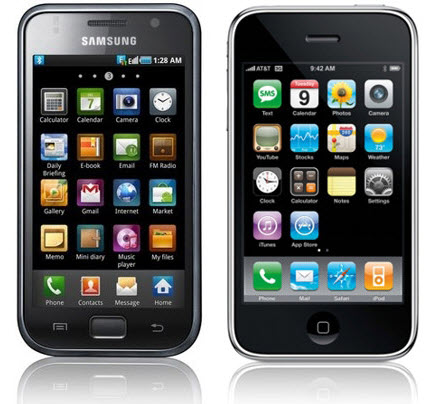
The mobile industry is heading in a single direction and has been since the first iPhone came out. The large touch screen interface, generally easy to use OSes and UIs, push email and installable apps were bound to emerge on any platform as technology advances. The importance is who gets their stamp on an improved existing idea first; and that person (company) will then become the school child in a playground who thinks he’s reinvented how to build a sand castle and will challenge anyone who says otherwise.
So where does Windows Phone stand then? For the past 18 months, every Windows Phone review has noted the radically different UI and the way things work. However, beneath the surface, all is still the same – easy to navigate UI, touch screen interface, apps. I’m not for a second saying that any of the items on WP are copied from any other company. I’m merely highlighting that the same functions can be integrated well into a phone OS without infringing anything, and Apple noted as such during the courtcase. The simple rule of thumb is just to be original, something many companies, technology or not, seem to be severely lacking these days.
Does Windows Phone have an advantage now? I would say a profound yes. While Apple and Samsung now tread very carefully, which means development will slow, Microsoft has a clean slate to push out as many new and exciting features and devices as it can. Plus for customers like me who do see the similarities in Android and iOS, it may be refreshing to actually change to a new phone OS in Q4 2012. The ruling against Samsung may even make the Korean technology company to spend more time on its Windows Phone 8 offerings; although it has released some Windows Phones already, Android has always been its main focus. However, knowing that Apple isn’t on a witchunt for Windows Phone may be a key incentive for it – but it will have to think up some new hardware designs.
The first round of the battle in the ever-growing smartphone wars has been fought. Apple emerged victorious, Samsung lost in court, but the true winner to me looks to be Microsoft.